Serial ROM Interface Cutout — the ‘Ashtray’

The ‘ashtray’ is the name given to space for the serial ROM socket to the left of the keyboard. The serial ROM interface is part of the Texas Instruments TMS5220-based speech upgrade. This consisted two chips and an external socket with the necessary connecting cable. The chips — the TMS5220 itself and a serial ROM containing digitised words and parts of words — were installed on the main PCB inside the computer whilst the external socket was to be fitted on the left of the keyboard PCB and protruded through the ashtray cutout. The cable was fitted next to the existing keyboard cable and connected the socket to the main PCB.
Acorn intended to release software and additional speech ROMs which could be plugged into the new socket, but nothing was ever released. Speech upgrades were often fitted without adding the external socket, presumably because customers preferred not to have it sticking out next to their keyboard.
A common third-party upgrade re-purposed the ashtray to house a 28 pin ZIF socket which acted as a remote sideways ROM socket. This allowed ROMs to be swapped quickly without the risk of bending their legs and avoiding the bother of opening the computer’s case and removing its keyboard to reach the internal sockets. The trade-off was that the ROM was left exposed next to the keyboard and at more risk of harm from static discharge and UV light — not really a sensible choice!
Four different treatments of the ashtray area were used during the production run of the BBC Micro.


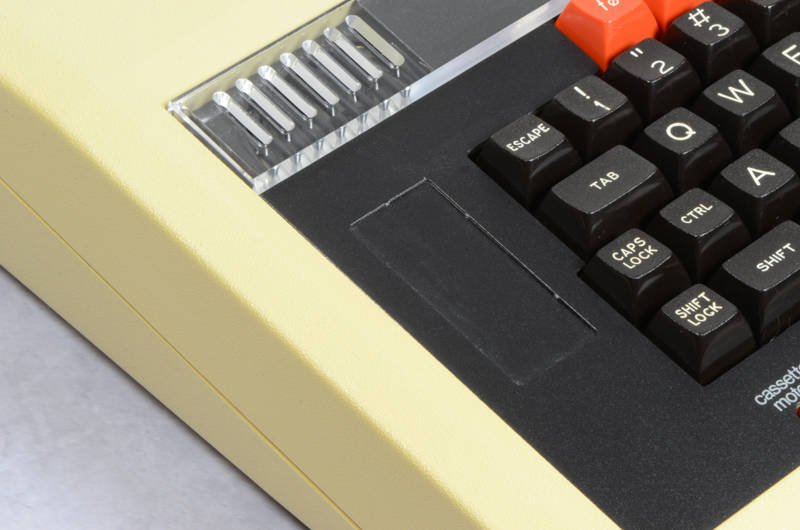
Open Ashtray

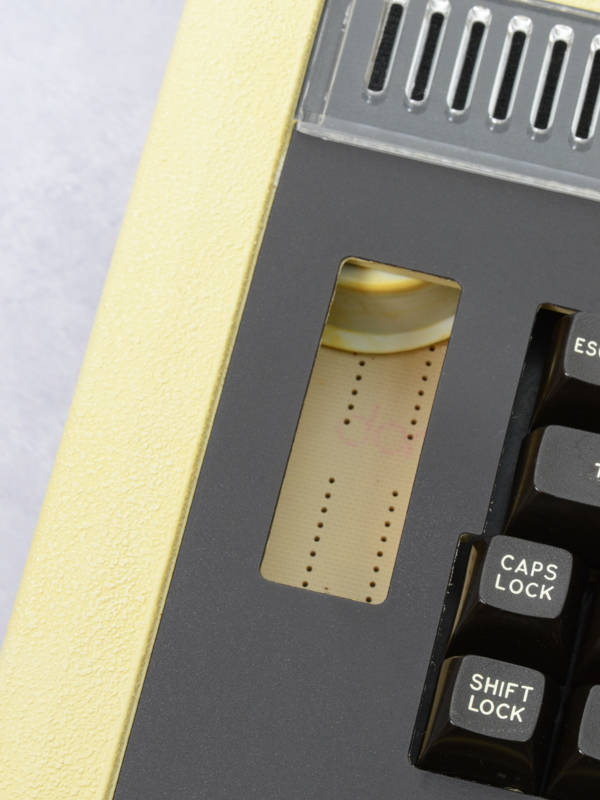
The open ashtray was a feature of the earliest BBC Micros, as can be seen from pictures which accompanied the first magazine reviews. Leaving the opening uncovered was consistent with the treatment of the unused sockets on the back of the case, which were left open and not blanked either (Econet and Reset in the case of a Model B).
The opening has radiused corners, in contrast with the perforated cover, where the corners are square. This makes it possible to distinguish a case which has had the perforated cover removed from one which never had a cover.
In some cases, the cut out ashtray cover is still in place, presumably held there by the adhesive-covering paper backing of the keyboard surround. Examples of this are uncommon and it is unknown whether the decision was made at the factory to keep the ashtray cover in place or whether it was just the luck of the draw as to whether it became detached when the keyboard surround was stuck to the case.
Covered Ashtray


The fully covered ashtray gives the cleanest appearance but it is relatively uncommon. It was used for only a short period of time, before and after which the open cutout was used. Perhaps the open cutout returned because service centres experienced difficulties in accurately marking out the area to cut when installing the serial ROM socket.
Cleartone and ICL were the only manufacturers to build machines with a covered ashtray.
Cleartone-built computers with serial numbers roughly between 102500 and 104000 had covered ashtrays. Almost all of these had Issue 2 boards, whilst only a few hundred had Issue 3 boards. It is also likely that Cleartone used a covered ashtray earlier in the Issue 2 production run, with serial numbers 100483 and 100662 being two known examples.
Covered ashtrays featured on ICL-built machines in the approximate range 002200 - 006800. All of these had Issue 3 PCBs.
In total, about 5,600 - 6,300 computers were built with this style of ashtray cover.
Perforated Ashtray Cover


This is the most common treatment, which despite looking flimsy is quite hard wearing. It was able to resist the majority of attempts by schoolchildren to push it through!
Tacked Ashtray Cover


This style is unique to Wong-built computers and is as fragile as it looks. The blanking cover is slightly recessed and only attached in six places. This matches the style of the blanking cover for the Econet socket on the back of the case.