SCL Unicorn
A BBC Micro built in India
Unicorn Computer PCB, D 1597 PSU, built by Semi-Conductor Laboratory
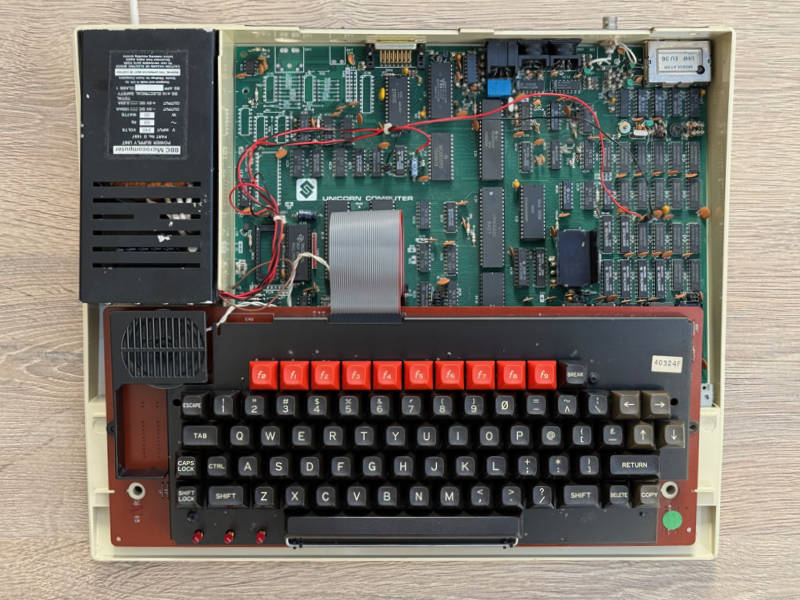
This computer was built from at least three different machines. The case and keyboard are from an Issue 4 or Issue 7 but the power supply is an early type D 1597 linear model. This is already an unusual combination of components, but the PCB is the most interesting part. It was made by SCL in India and is labelled ‘Unicorn Computer’.
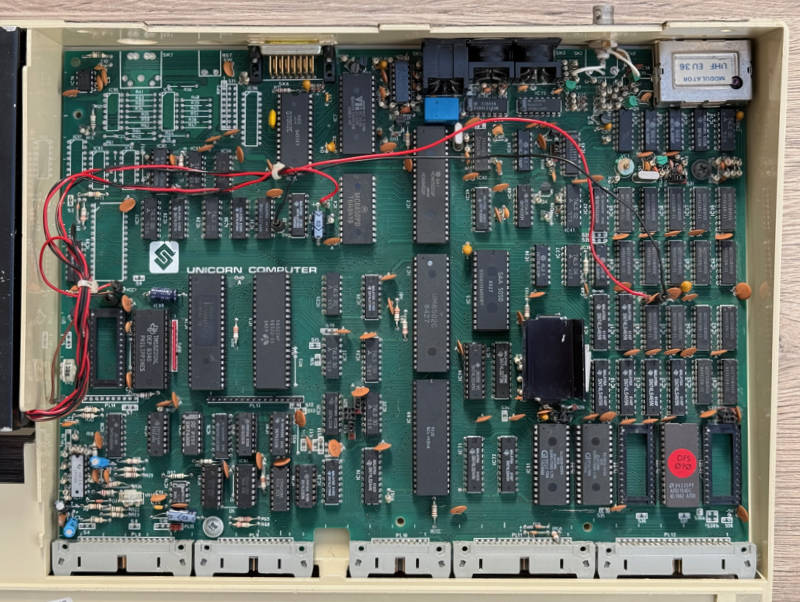
Not much is known about SCL and the Unicorn Computer (or SCL Unicorn), other than it was built under licence from Acorn for the Indian market. Only three other SCL Unicorn PCBs are currently documented. They are:
- Number 0007502 at Chris’s Acorns, housed in a coarse texture BBC Microcomputer case with an early type 1 (Futaba) keyboard. Now owned by the Centre for Computing History in Cambridge.
- Number 0007992 also owned by the Centre for Computing History (PCB only).
- Number 0008058 mentioned in a StarDot forum post in 2020, at which time is was owned by CJE Micros (PCB only).
The Centre for Computing History claims the computers were built by SCL in 1985-1986. At this time Acorn were producing the B+ and then the Master 128 in the UK market. The CPU Shack suggests a longer production run, with SCL acquiring the licence from Acorn in 1984 and producing 3,600 computers by 1988 with a target of 250,000 units by 1990. Although there is only a small sample of PCBs to go on, the serial numbers suggest this target was not reached.
No existing PCB is known to be housed in an original SCL Unicorn case.
Previously I speculated:
Presumably all these PCBs were originally housed in an SCL Unicorn branded case. I can’t find any photos or documentation which describes what it looked like. It could have been an exact copy of the BBC Micro case, using the same keyboard and an identical colour scheme, but most likely with a different name on the function key strip and labels.
But see below for a definitive answer!
Details
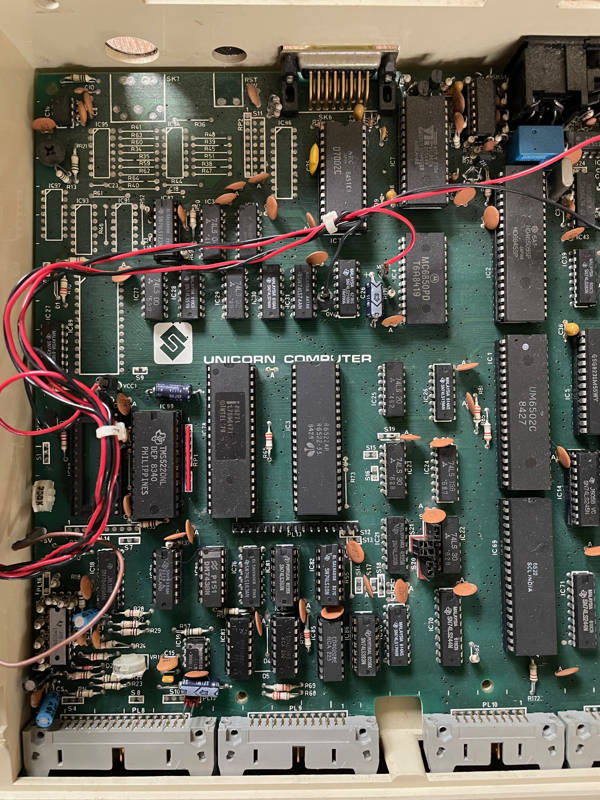
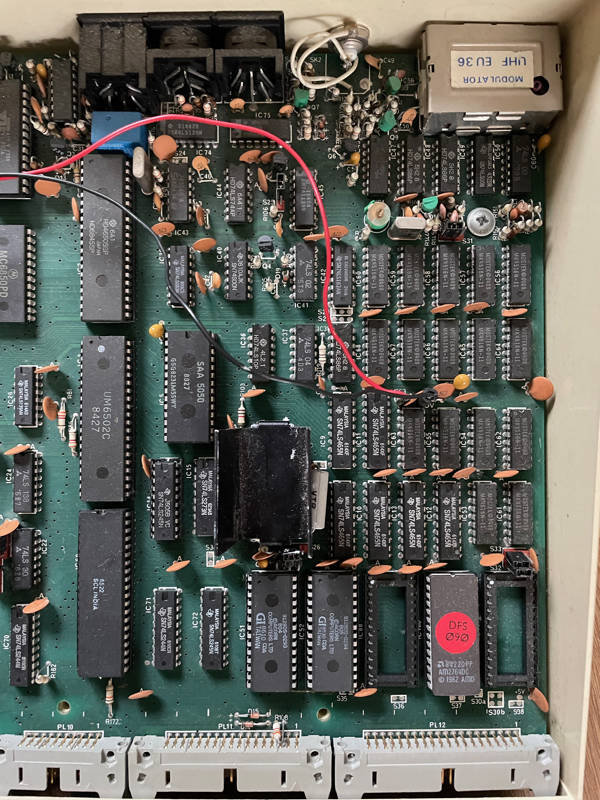
The computer is in working condition, but not all of the chips on the PCB are original. Based on the other known PCBs, I would have expected both 6522s and the 6502 to be SCL branded but unfortunately only one original 6522 remains.
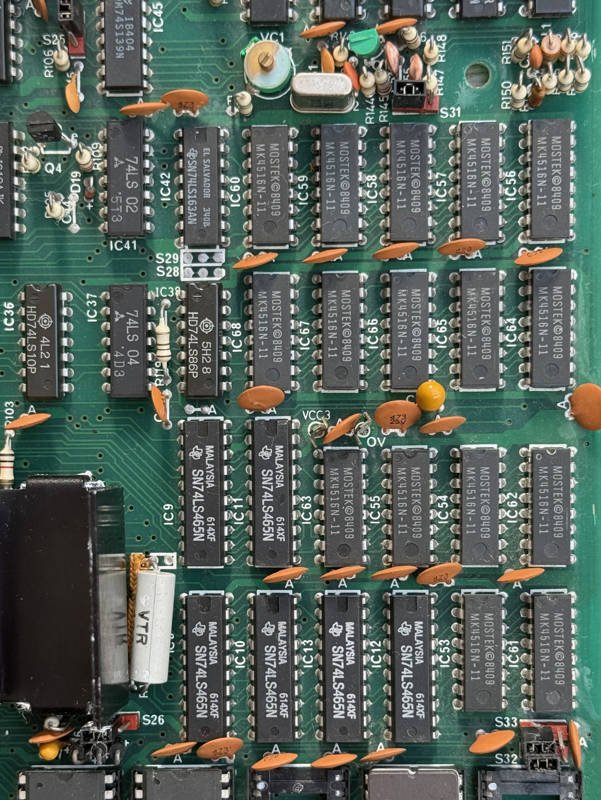
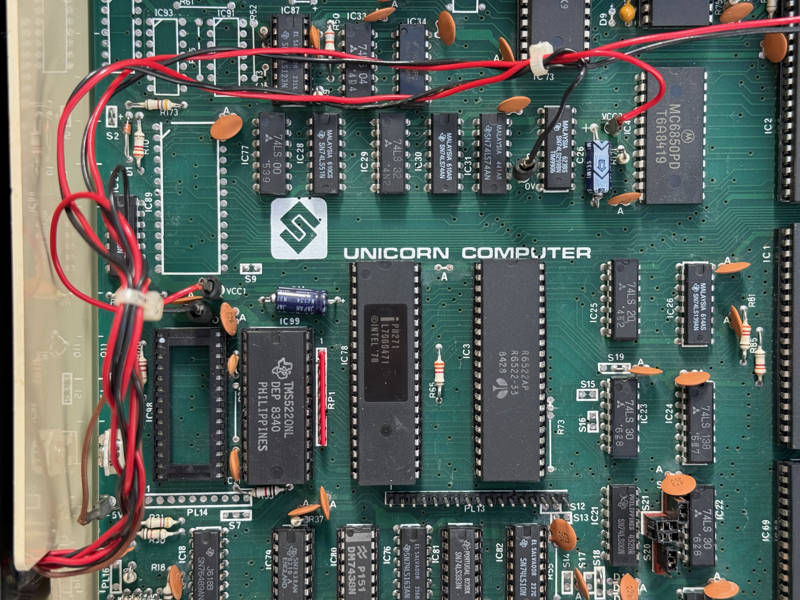
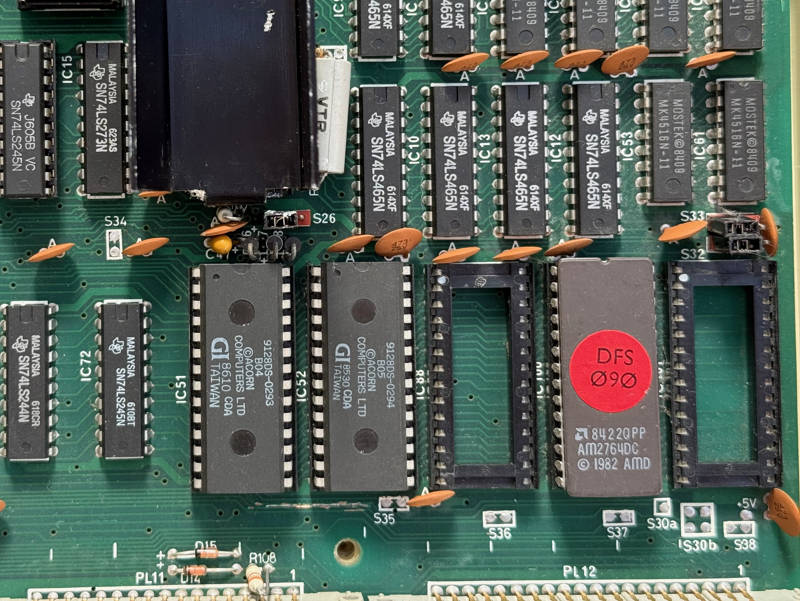
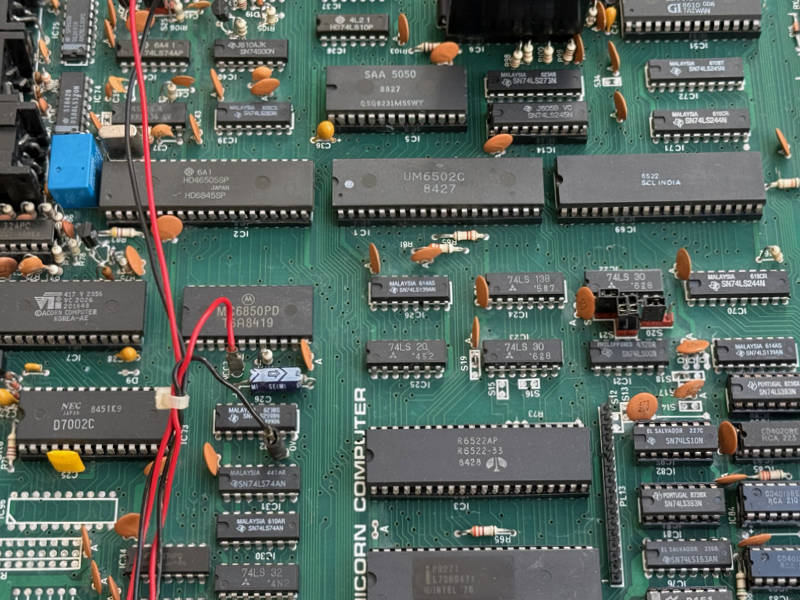
The CPU is labelled UM6502C. Radiomuesum’s database suggests it’s made by Unicorn Microelectronics Corporation (UMC) of Taiwan. Is the computer named Unicorn because of a collaboration between SCL and UMC, or is it just by chance?
The Chris’s Acorns and CJE computers both have an SCL-branded 6502, so the one on this computer might have been replaced, or it could be the original part which was used before SCL-produced ones were available.
Comparison with Other SCL Unicorn PCBs
Unlike the other known Unicorn PCBs, this one does not have a serial number. The labelling is also different: “Unicorn Computer” in the Microgramma font (the same as the Acorn-produced boards), whereas the others are labelled “Unicorn Microcomputer” in a Helvetica-like font.
The PCB itself is a much darker green, so it must be from a different batch and was probably even made by a different subcontractor. It’s the only known SCL Unicorn PCB of this type.
In common with the other three known PCBs, the UHF modulator is labelled “Modulator UHF EU 36”. At the time, India used the PAL TV system, though I don’t know whether it was the same variant that was used in the UK. There is a chance that they are all original. An alternative theory is that all boards were imported to the UK by the same company, which replaced the modulators with a standard part. This seems unlikely because the replacement would certainly have been the Astec-branded part found in domestic market computers of all makes.
A feature shared by this board and both of those owned by the Computing History Museum is that they all have a TI TMS5220 speech processor fitted, but they all lack the accompanying phrase ROM (PHROM). The speech system can still function without this by using data stored in main memory, so perhaps it was part of the specification at the time of manufacture.
Also in common with the Chris’s Acorns board is the video ULA heat sink, which looks the same as the one usually fitted to the Ferranti variant of the chip. The CJE Micros board has the VTI part which does not require a heat sink. It’s also the latest of the three serial numbered boards, which might be the reason it has the more recent chip. Or it could simply be a replacement for the original.
The CJE board has no disc or Econet interfaces but the PCBs owned by the Computing History Museum have both. My PCB has a disc interface but no Econet. The SCL Unicorn brochure lists the names of four different configurations but doesn’t give exact specifications. It’s likely that one of the configurations came with factory-fitted Econet and the CHM’s boards are examples of this.
All known SCL boards are built to Model B specification with the full 32K of RAM soldered directly to the PCB. A Model 16K A equivalent was probably never considered!
The operating system and BBC BASIC are both on mask-programmed ROMs, made in Taiwan with 1985 and 1985 date codes respectively. These seem to be unique to the SCL machines — I have not seen them elsewhere. The OS ROM on the CJE board is labelled differently and probably produced by a different manufacturer.
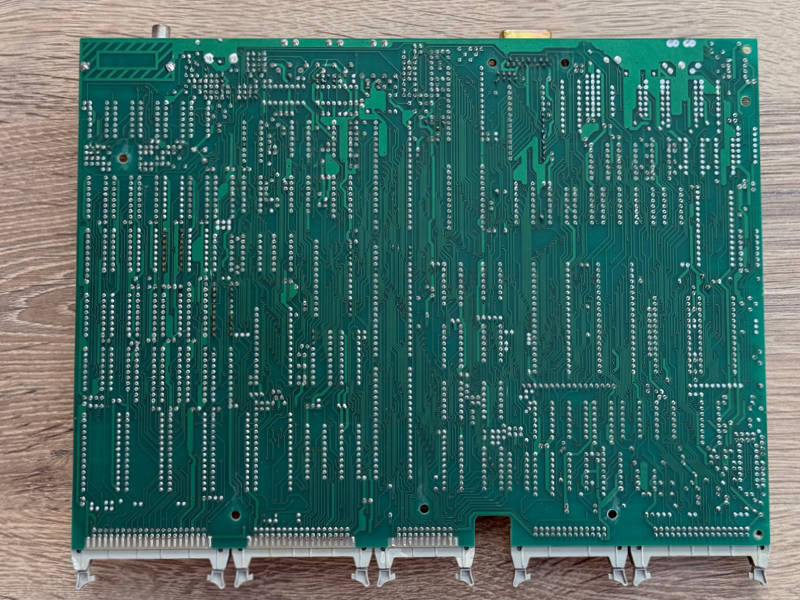
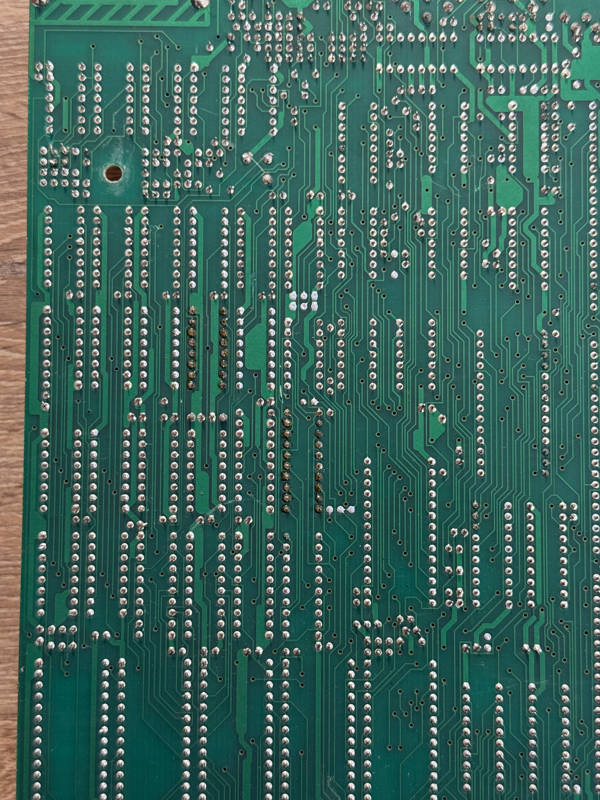
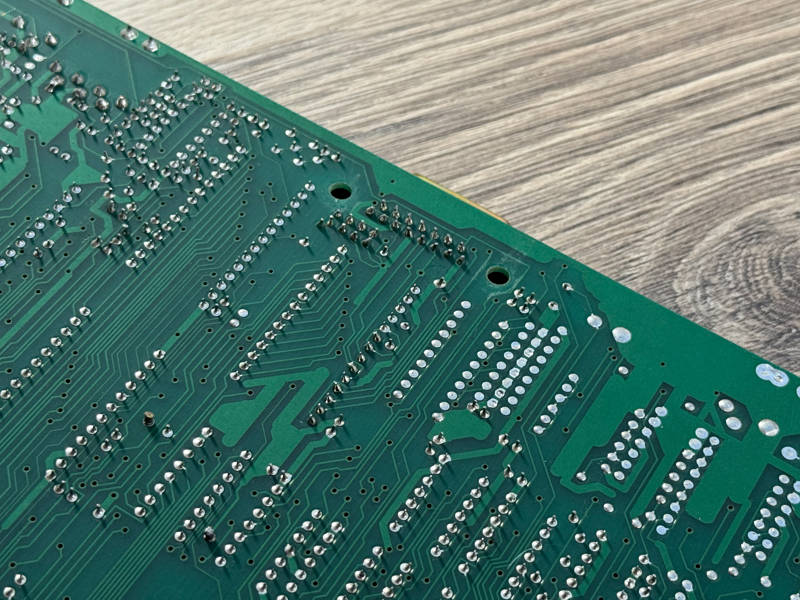
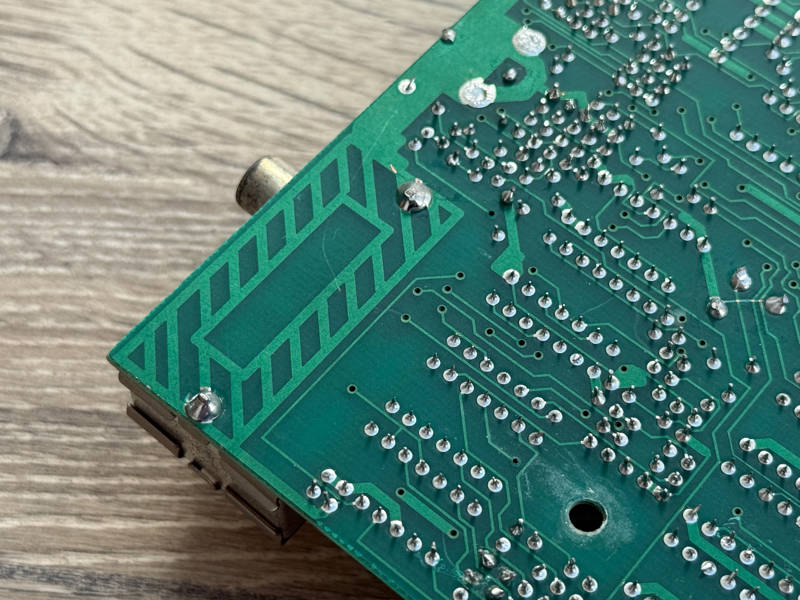
The underside of the PCB shows a few areas of re-soldering but the affected chips do not seem to have been changed. The name of the PCB manufacturer is usually shown in the area underneath the UHF modulator but on this board it is blank. On the CJE board, this area contains the text: “PCB MANUF MP”.
The Computer Itself
So far I’ve focused on the PCB because that’s the only part of an SCL Unicorn I have. However here are some photos which show the computer in the configuration it was in when I acquired it in early 2023. It’s quite a collection of components!
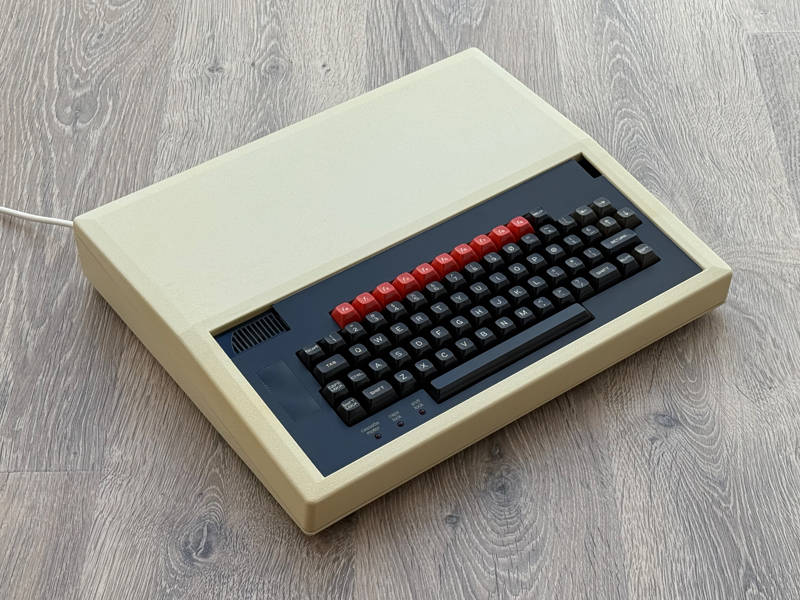
The function key strip is missing. That’s a shame because it would have been badged “SCL Unicorn Microcomputer System”. Looking underneath reveals that there’s no serial number either, so we can’t know the identity of the machine that the case came from…
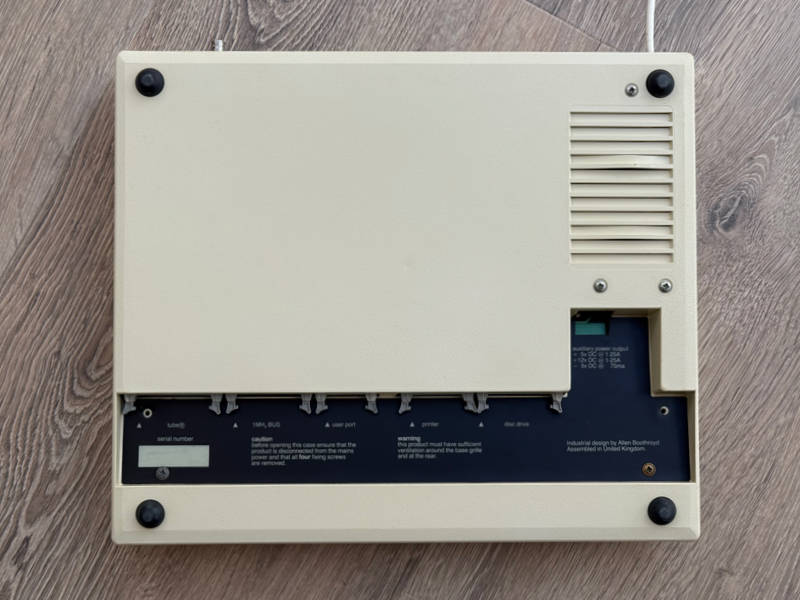
…but the labels show definitively that the case is made in the UK so it doesn’t belong to an SCL Unicorn. The label on the lower case reads “Assembled in United Kingdom” and the one on the back states “Designed by Acorn Computers Limited, Cambridge. England”.
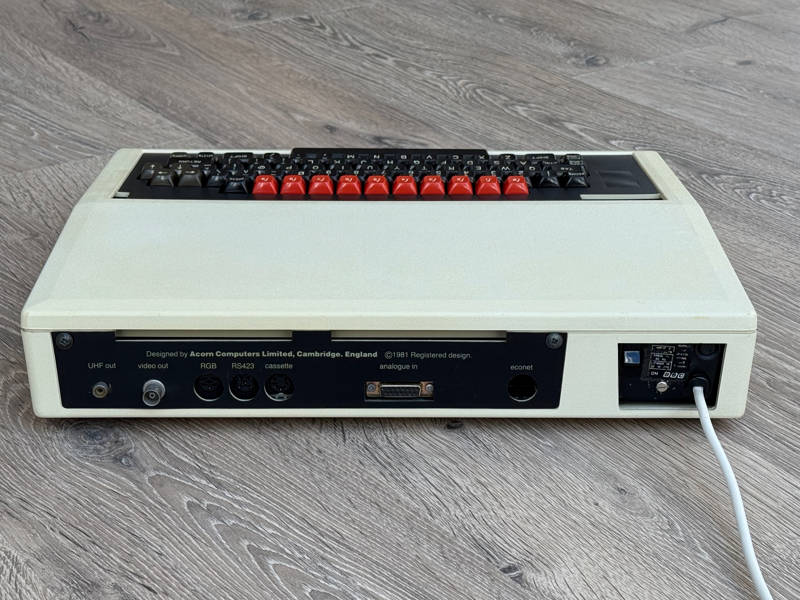
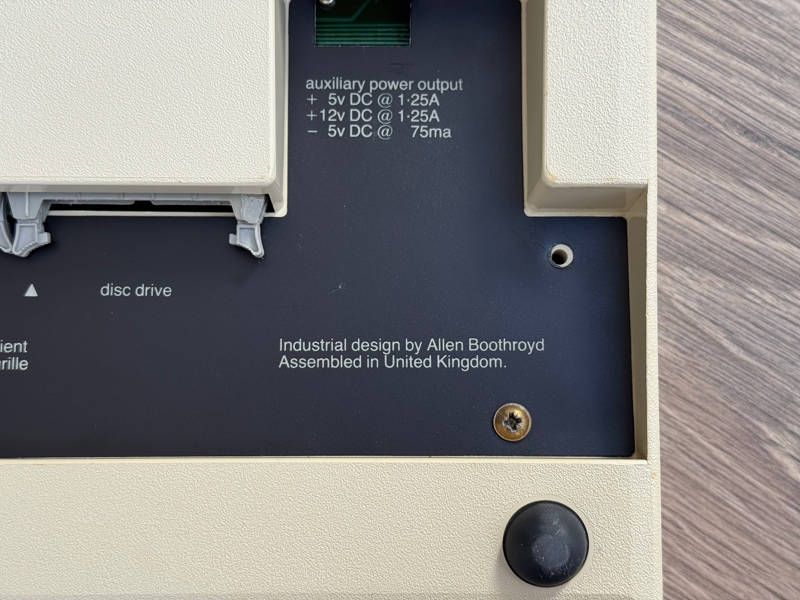
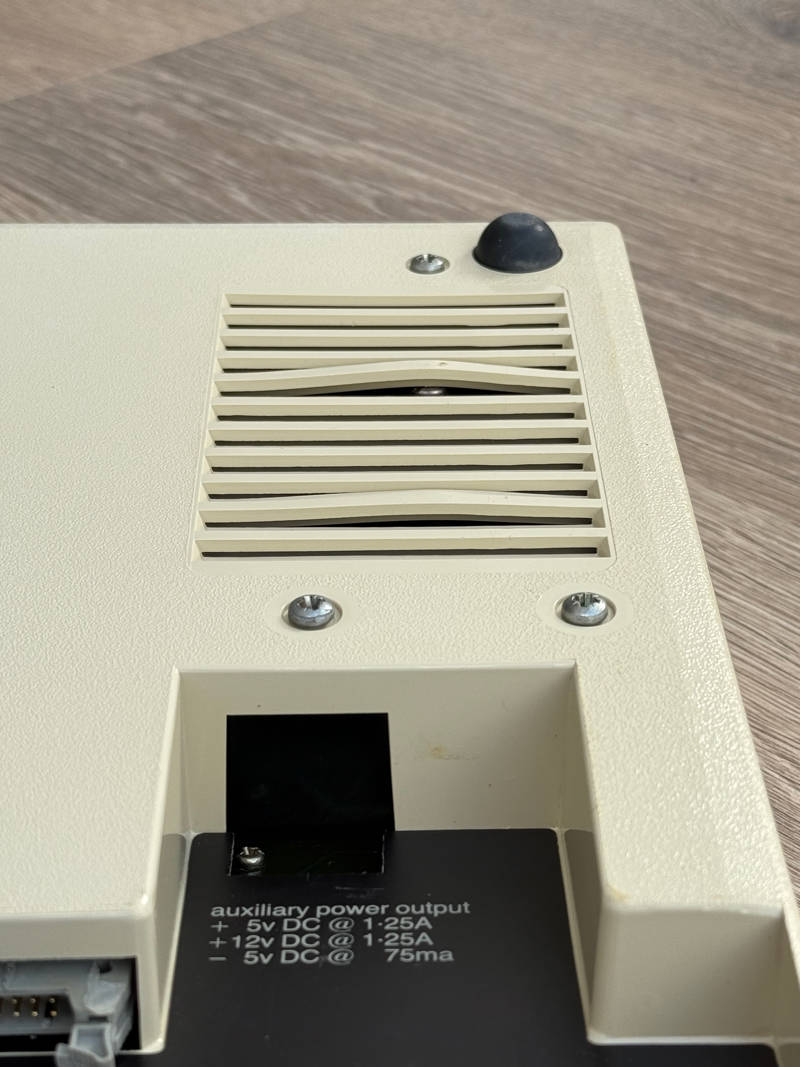
The D 1597 linear power supply is from a Cleartone or AB Model A. It’s the oldest part of the computer, pre-dating all other parts by a couple of years. A couple of the cooling slats have been bent by screws on the underside of the PSU. The later case isn’t designed to accommodate this type of power supply but whoever shoehorned it in didn’t realise that.
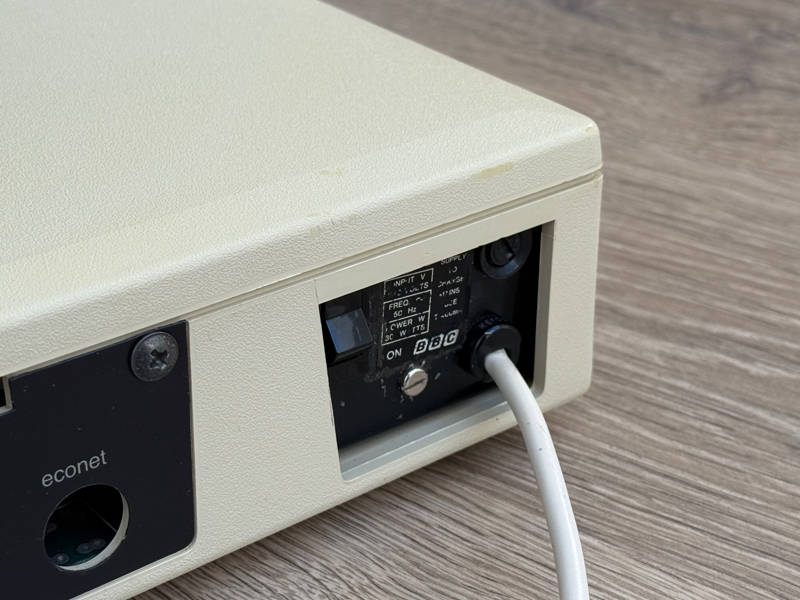
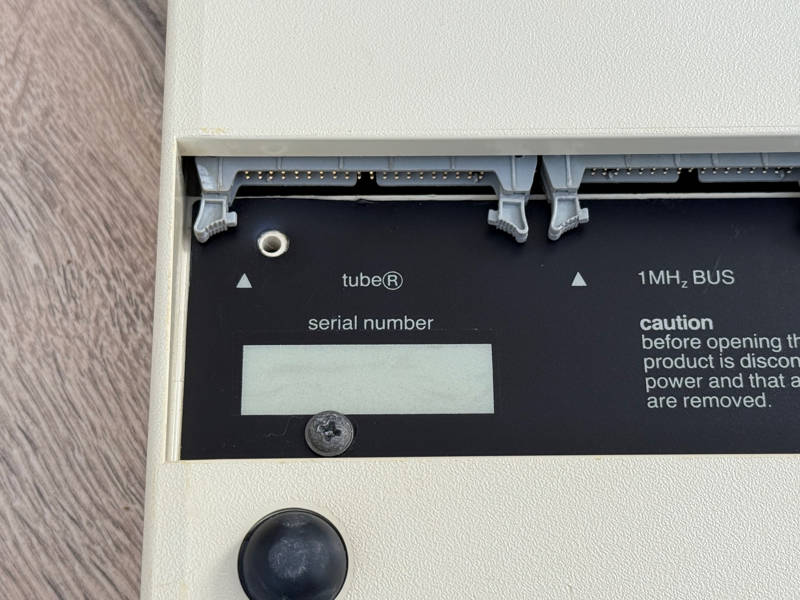
The keyboard is a “type 2”, which uses SMK angled keyswitches and keycaps that are unique to that type of keyswitch. The SCL Unicorn brochure doesn’t show any machines with this type of keyboard.
Inside, the keyboard connector cable has been lost and replaced by a ribbon cable with IDC connectors at each end. There are only two retaining screws for the PCB (there should be five) and the keyboard bolts are missing too.
In Use
The whole computer is in working order — and with a linear PSU there are no exploding capacitors to worry about. On startup it presents the familiar “BBC Computer 32K” banner because, from a software point of view, that’s exactly what it is. The OS is version 1.2, accompanied by BASIC 2. The DFS is a the standard Acorn 0.9 version. I haven’t done any further testing yet.
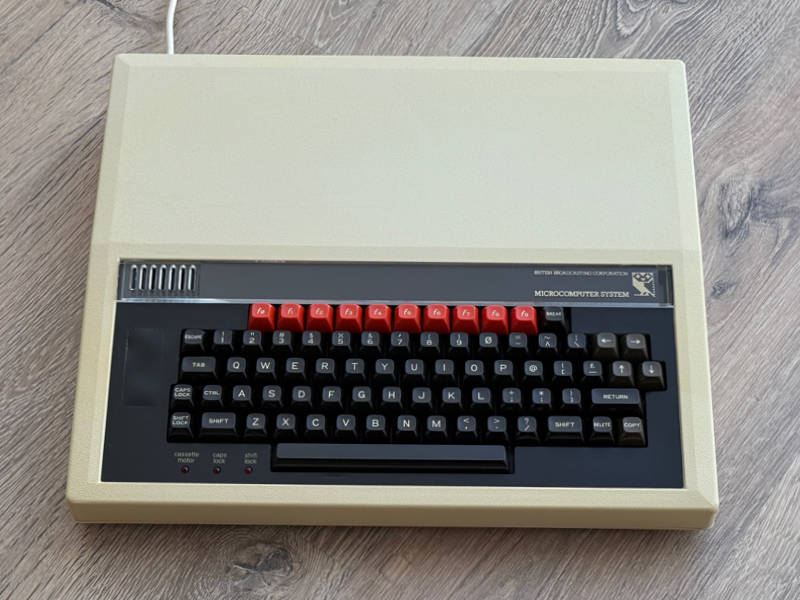
Since acquiring the computer I’ve dismantled it, cleaned it and reassembled it. The photos you see on this page are taken after this was done. No repairs were needed but I have added a function key strip to make it look more complete, even though the branding is wrong.
Did the SCL Unicorn Look Like a BBC Micro?
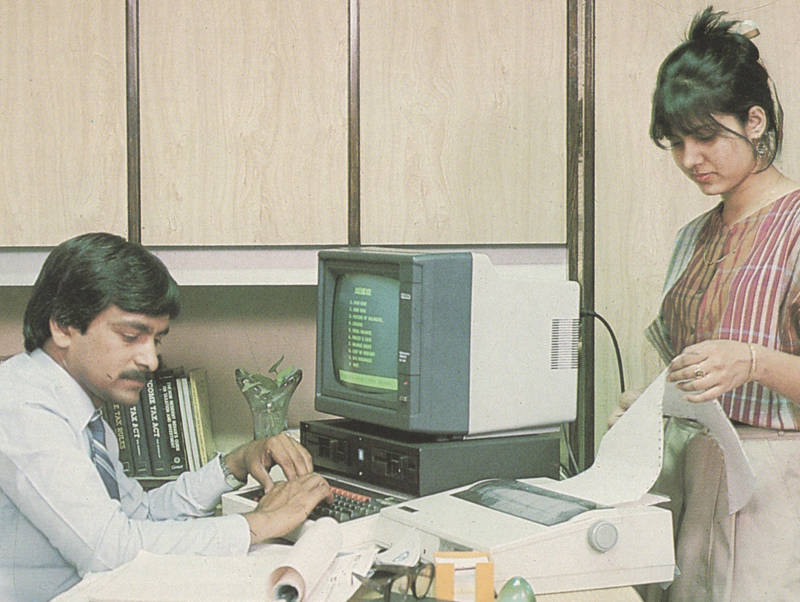
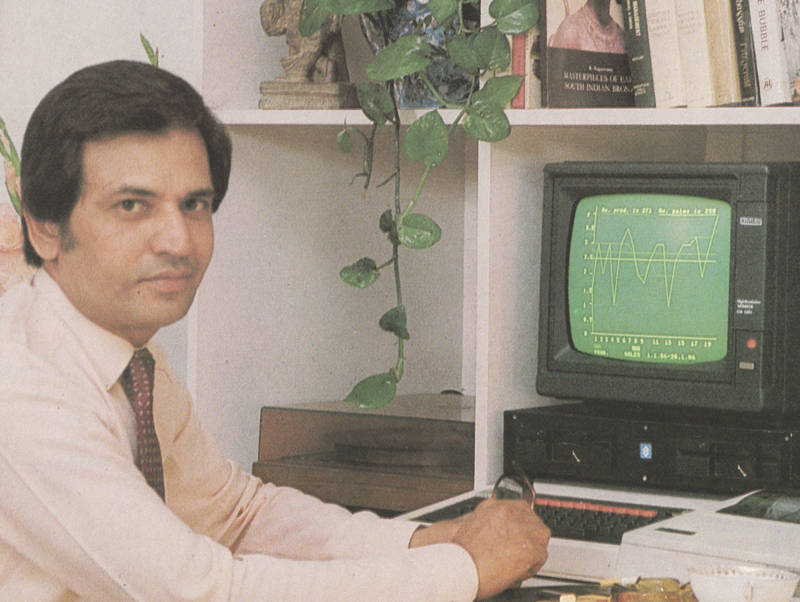
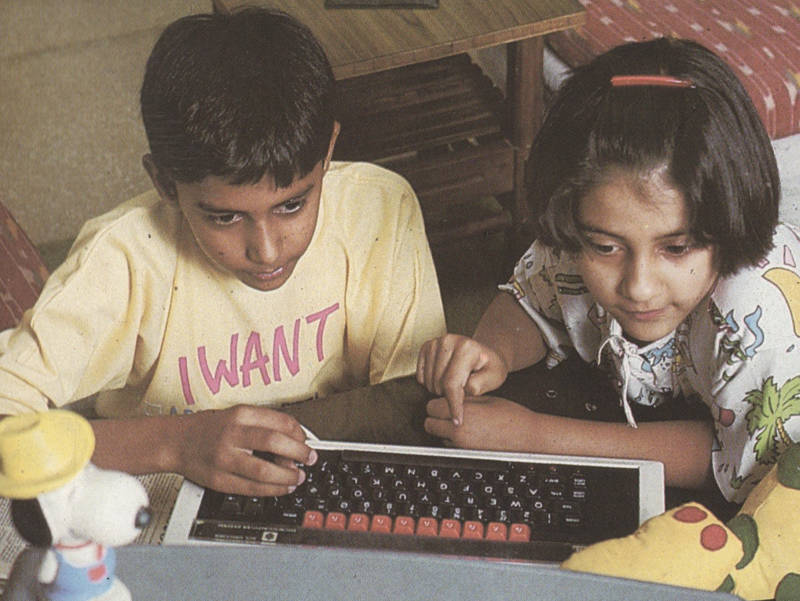
Thanks to Mr A. Williams, who kindly sent me a scan of the SCL Unicorn brochure, I now have a definitive answer: Yes, it looked exactly like a BBC Micro, differentiated only by the logo on the function key strip which reads “SCL Unicorn Microcomputer System”.
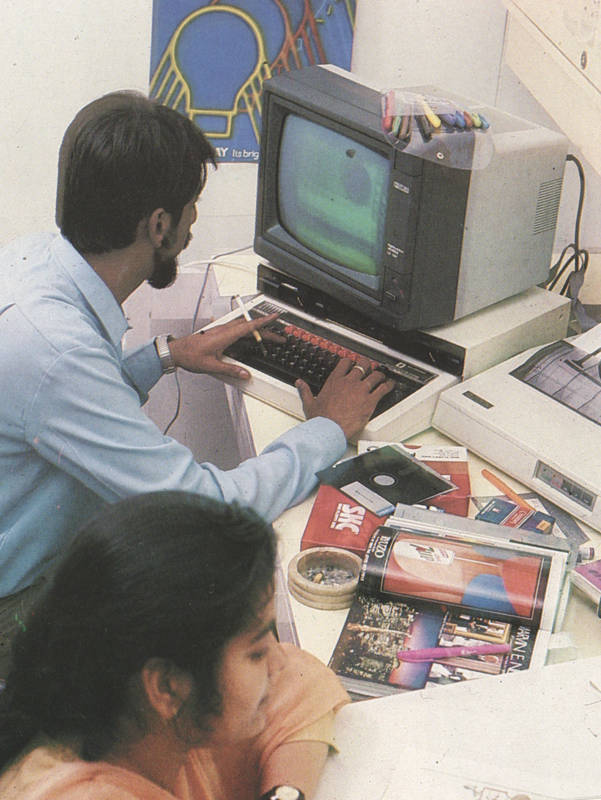
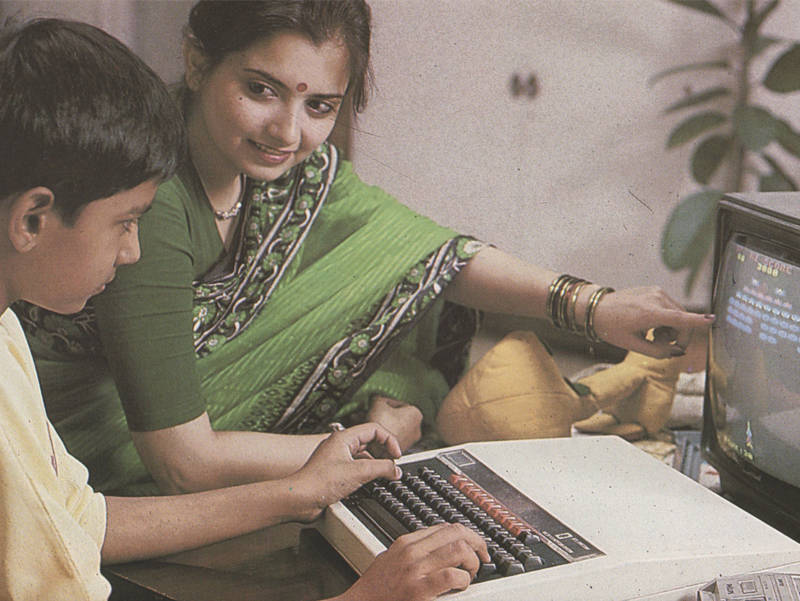
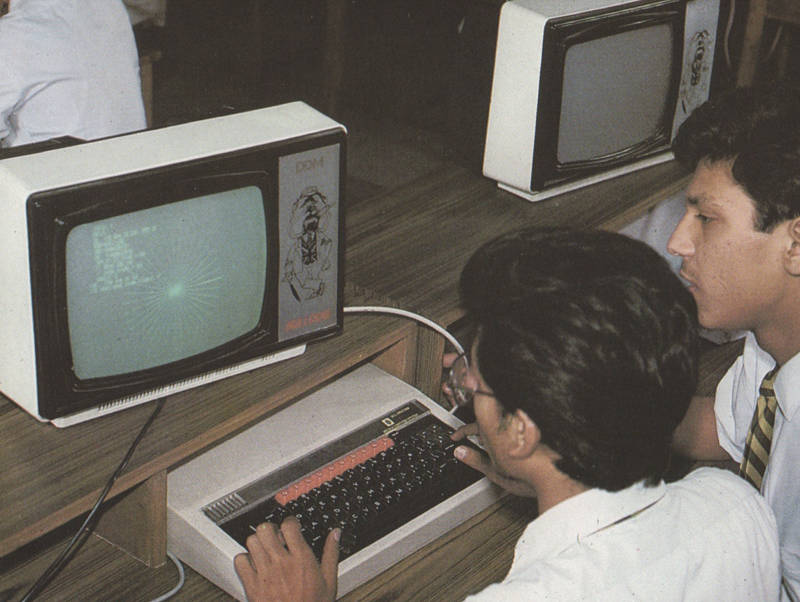
The case is the later fine textured version. The keycaps show that the keyboard does not use the SMK angled keyswitches. In fact it’s most likely to be the ubiquitous Futaba-based variety (Type 1) but there is no way to determine this with certainty from the photos. The back and insides of the case are not shown so we can’t see any details of the power supply and discover whether it’s the standard AA 11660 or a locally-produced substitute.
The scanned brochure was originally provided to Barson Computers in Melbourne when they were approached about a possible deal to distribute the machine in the Australian market. Barson’s existing contract with Acorn would have forbidden them from selling a clone so the negotiations came to a swift halt. No-one at Barson ever saw one of the machines, so it is doubtful whether SCL ever found a distributor outside India.
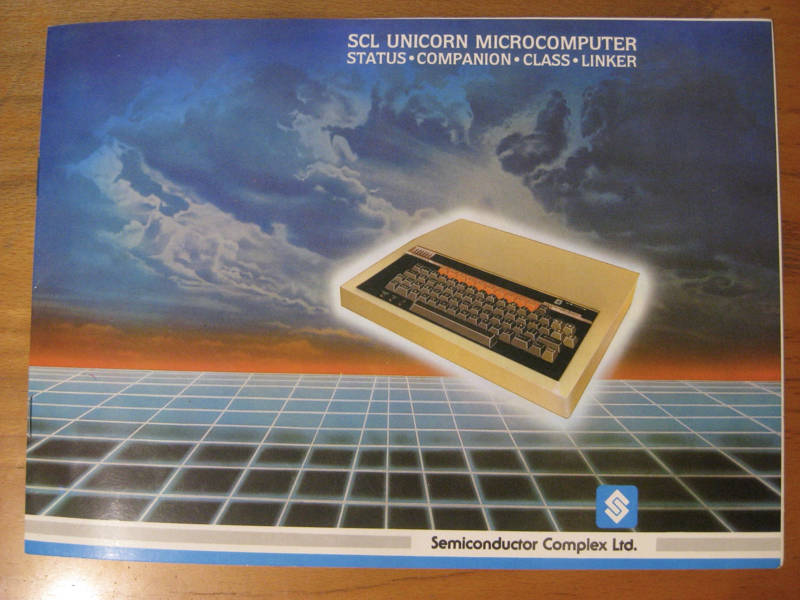
The brochure describes four configurations — Status, Companion, Class and Linker — but doesn’t explain clearly whether they are different hardware specifications or simply a variety of software bundles.
SCL Unicorn Configurations
Status: for the home market. Possibly a standard Model B without a disc interface.
Companion: for businesses: Model B with a disc interface, twin double-sided 80 track drives and possibly a monochrome monitor. The brochure claims the software bundle is useful for “Chartered Accountants, Lawyers, Architects, Doctors, Astrologers and many more” — Astrologers being a particularly interesting segment to mention.
Class: for schools: Likely just a standard Model B. It would make sense for this variant to have Econet, but the brochure doesn’t specify this. But it does say “SCL Unicorn is compatible to BBC Micro of U.K. which is used at all schools in Europe.” — quite a wild claim!
Linker: a standard Model B with terminal emulation software.
The brochure also mentions various firmware and software including Wordwise Plus and Image.
The specification page describes the standard BBC Micro but also includes features that are upgrades or even separate products in the UK market, without specifying which ones are extras. Disc interface, Econet and even a Z80 second processor are listed. Screen resolutions are the same as the UK market, unlike the USA version which had fewer vertical lines. The TV modulator provides 625 line PAL encoded output and there is also a hint that the composite video output has been modified to support colour.